By mid-morning the sky has gone flat and white, the block across the road is a grey outline, and there’s that faint burnt smell in the lift lobby. If you’ve sat through a hazy stretch in Singapore, you know exactly what comes next: windows stay shut, the air-con runs longer than it should, and a thin grey film shows up on the coffee table about a day after you last wiped it.
What catches most people out is how differently you have to clean while the air outside is bad. Run a dry duster along a shelf and you’ll throw more particles into the room than you pick up. Fling the windows open at the wrong hour and you’ve undone an afternoon of work. Adjust the timing and the technique a little, though, and a hazy fortnight stops feeling like a losing battle.
What Haze Does Inside Your Flat
Haze particles are much finer than ordinary house dust, which is why closing the windows doesn’t keep them out. The National Environment Agency explains that fine particulate matter enters air-conditioned buildings through fresh air intakes as well as through openings and gaps, and that particulate levels indoors can build up to unhealthy levels. A PSI reading of 101 and above counts as unhealthy, and during the Southwest monsoon those readings can stay there for days.
So the grime landing on your shelves in a hazy week behaves differently from normal dust. It’s lighter, and stickier too. It works into fabric, collects along skirting boards, and floats straight back up if you disturb it without lifting it away.
You’ll spot it on dark surfaces first. A black TV console or a glass dining table will look grey again two days after you wipe it.
Put the Feather Duster Away
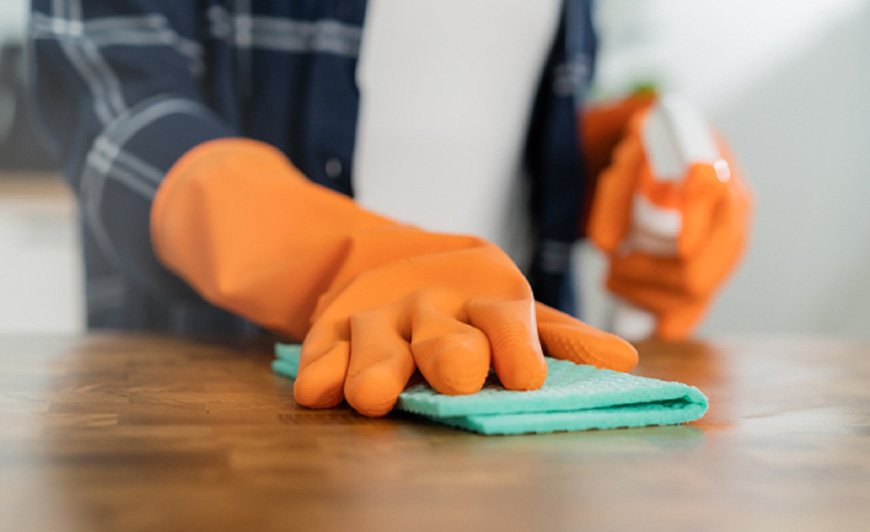
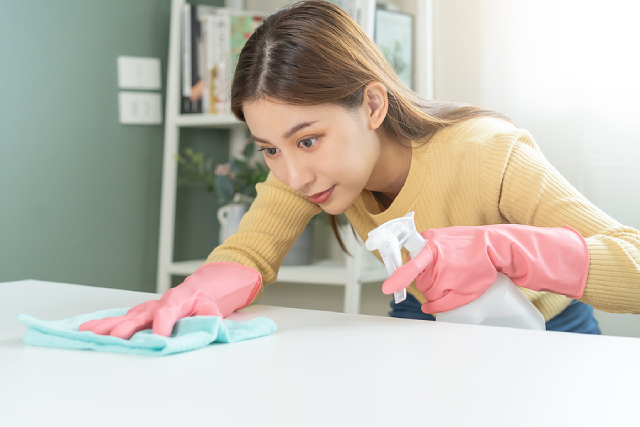
Health guidance published on Singapore’s HealthHub recommends wet-cleaning methods such as mopping and wiping over dry dusting, because dry methods send particles back into the air and leave them circulating. Keep a bucket of clean water beside you, wring out a microfibre cloth, and rinse it every few surfaces. Ten minutes of that gets you further than half an hour of dry sweeping. Mop the hard floors, and change the water more often than you normally would, because it’ll go grey fast. Use two buckets if you can, one for washing and one for rinsing, so you’re not putting the same grit straight back down.
Households that already book weekly house cleaning tend to ride out these stretches more easily, since floors, ledges and bathrooms get handled on a set schedule and not whenever somebody finds a free hour. Our part-time cleaners will also point out the spots that need a second pass, which saves you hunting for them yourself.
Where the Fine Dust Lands First
Work through these in order and you’ll see the biggest change for the least effort:
- Window ledges, grilles and the tracks of sliding doors, where outdoor air arrives first
- Ceiling fan blades and the top edges of wardrobes and kitchen cabinets
- Air-conditioner and purifier filters, which clog noticeably faster during a hazy spell
- Curtains, cushion covers, rugs and bedding
- Floors along the skirting, where fine dust drifts and gathers
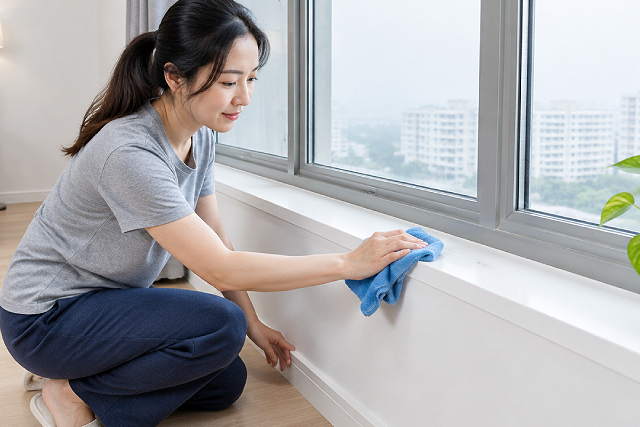
Window tracks are easy to overlook. Fine dust mixes with the damp sitting in a sliding door channel and sets into a dark paste that no vacuum will lift, so reach for a stiff brush and a damp cloth. Same story with the grooves in casement frames and the gap behind the air-con unit. Both sit right where outside air comes in.
Don’t skip the filters. A clogged one quietly stops doing its job, and if you leave it until the haze clears you’ve wasted a fortnight of wiping.
Keeping Air Moving Without Letting More In
Shutting the flat up helps, though the air inside still has to move. HealthHub’s advice during poor air quality is to keep doors and windows closed, run fans or the air-conditioning to keep air circulating, and shut the outdoor air intake on window units. A portable purifier in whichever room your family actually sits in will bring particle levels down further. Point it away from a wall and give it a metre of clear space, otherwise it just keeps pushing the same air around.
Then there’s the laundry. Hang a rack of wet clothes on the service balcony during a hazy stretch and it comes back in smelling of smoke, so bring the rack indoors and run a fan across it, even though everything takes longer to dry. Bedding and towels are the ones to protect. They spend the most hours against skin.
Keep half an eye on the readings. Once the 24-hour PSI drops back into the good or moderate band, throw everything open and let the flat air out for an hour or two. That’s also the moment for the bigger jobs: curtains into the machine, beds stripped, all the fabric that’s been quietly collecting particles all week.
The Soft Surfaces Most People Forget
Curtains, cushion covers, rugs and mattresses soak up fine particles and let them go again slowly, every time somebody sits down or brushes past. Usually that’s why a room still feels stuffy after every hard surface has been wiped. Wash whatever fits in the machine. Vacuum the rest with an upholstery nozzle, working slowly, and you might be surprised what comes out of a cushion you thought was clean. Pillowcases are the simplest thing to change. Swapping them twice a week during a bad spell costs you nothing and makes a real difference to how you sleep.
Most of the reasons why dust is accumulating at home apply all year round. Haze just makes them impossible to ignore.
Getting Back to a Home That Feels Fresh Again
Hazy weeks pass. A flat that felt stuffy and stale on Monday can feel completely different by Saturday with a bit of steady attention, and none of it needs special kit. Damp cloths, a mop, clean filters and sensible timing with the windows will carry most homes through.
Older family members, young children and anyone with asthma feel bad air first, so start with their rooms when time is short.
If your week leaves no room for any of this, we’re happy to talk through a regular cleaning slot that fits around your schedule.